Disarmament Times: January 2026
The Israel-Iran Conflict: The Urgent Need to Return to Diplomacy and Law
by Deepshikha Kumari
The eruption of hostilities between Israel and Iran last summer thrust the global nuclear non-proliferation regime into a perilous moment. Israeli airstrikes on Iranian nuclear …
Resolving the Israeli/Palestinian Conflict: A Symposium
Analyzing an ongoing conflict is a difficult task. On May 25, 2025, a panel of four women, each with a background related to the region under discussion, undertook the challenge of addressing the question: What will it take to achieve a lasting and just Israeli/Palestinian peace?
“EDITOR’S NOTE: An earlier version of this article was written in June 2025 and is reprinted here with permission of the author.”
The Israel-Iran Conflict: The Urgent Need to Return to Diplomacy and Law
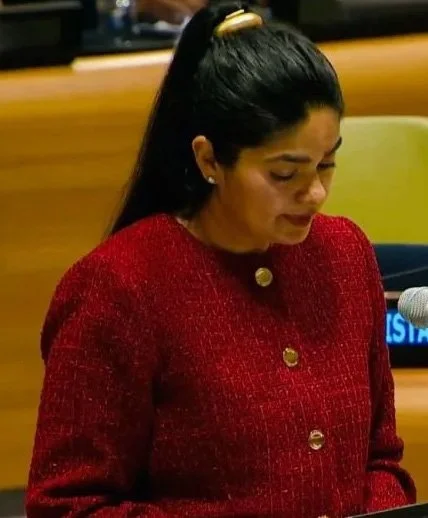
by Deepshikha Kumari Vijh, PhD., MA,. MSc. Executive Director, Lawyers Committee on Nuclear Policy
The eruption of hostilities between Israel and Iran last summer thrust the global nuclear non-proliferation regime into a perilous moment. Israeli airstrikes on Iranian nuclear infrastructure and other targets, followed by Iran’s ballistic missile retaliation and hints of withdrawal from the Nuclear Non-Proliferation Treaty (NPT), marked a grave escalation—not just for regional stability but for the international legal framework designed to prevent nuclear catastrophe.
As advocates for nuclear abolition, the Lawyers Committee on Nuclear Policy (LCNP) viewed these developments with profound concern. As early as January of 2025, LCNP published a statement opposing attacks on Iranian nuclear facilities as a grave mistake, arguing that even in the unlikely event a bombing campaign were successful in completely destroying the existing facilities, it would not eliminate the danger. The danger will persist from the knowledge and construction capabilities Iran has acquired. As a threshold nuclear state it could recreate its program in a relatively short time period. The full statement can be found here.
The world has now witnessed the feared military attacks on Iranian nuclear facilities—which not only risked environmental devastation but may also not meet the requirements of necessity and proportionality. More fundamentally, the attacks imperil the legitimacy of the global non-proliferation system anchored in the NPT and the verification regime of the International Atomic Energy Agency (IAEA).
Iran’s signals in 2025 that it may abandon the NPT, combined with increasing uranium enrichment far beyond civilian needs, are indeed serious breaches. Yet, addressing them through force only reinforces the narrative that international agreements are irrelevant, and security can only be found in nuclear deterrence. This is a recipe for proliferation, not peace.
International law is unambiguous on these matters. The UN Charter prohibits the use of force except in cases of self-defense or with explicit Security Council authorization. It does not permit anticipatory self-defense based on assumed threats from safeguarded nuclear facilities. The IAEA made clear through its June 2025 resolution that Iran’s level of cooperation was unacceptable. Yet its processes must be respected—not bypassed through kinetic strikes that could themselves trigger wider war.
The IAEA, through its June 2025 resolution, rightly called on Iran to restore full compliance and transparency. Iran must return to verifiable commitments, but doing so under the threat of bombing and military attacks reinforces the notion—dangerous and false—that only nuclear weapons can guarantee a state’s survival.
Moreover, the timing of this crisis—less than a year before the 2026 NPT Review Conference—could not be more consequential. If Iran exits the Treaty, other states may conclude that the pursuit of nuclear weapons is the only rational path to ensure survival in a world where legal norms are seen to be applied selectively and power is enforced unilaterally.
As a threshold nuclear state, Iran could rebuild swiftly. Strikes of this nature reinforce the very logic of nuclear deterrence they claim to resist. This was affirmed at the United Nations Security Council on June 22 as the Secretary-General called the U.S. and Israeli strikes a “perilous turn,” while IAEA Director General Rafael Grossi confirmed visible craters and severe damage at Natanz and Fordow. Despite Iran’s breaches of safeguard obligations—including uranium enrichment beyond civilian thresholds—this does not justify kinetic action. As the IAEA reiterated, inspections and diplomacy remain the only lawful path forward.
The Security Council has not authorized the use of force against Iran. Article 51 of the UN Charter provides for self-defense only in response to an armed attack—not preemptive strikes on sites under international safeguards. To act otherwise is to declare the rule of law optional. Rather than turn a blind eye to law in moments of crisis, this is precisely when the rule of law must be reaffirmed. Nuclear disarmament cannot be achieved in a world where military force trumps treaties and verification. Instead, the international community must:
● Condemn attacks in violation of the UN Charter;
● Urge Iran to comply fully with IAEA safeguards;
● Reinforce the authority of the IAEA as the sole legitimate body for verification;
● Recommit to regional diplomacy, including long-sidelined efforts toward a Middle East zone free of weapons of mass destruction
The confrontation between Iran and Israel is not just a regional issue—it is a systemic warning. This moment is a test—not just of diplomacy, but of whether the global community still believes in normative restraint and international law. We cannot allow force to replace dialogue, or preemption to replace diplomatic prevention. A world in which military power overrides treaties is a world where nuclear weapons become more attractive, not less.
This crisis is more than a geopolitical flashpoint—it is a legal reckoning. It tests whether the global community still believes that treaties, safeguards, and peaceful resolution are the instruments of security. We must not allow the Bomb to become a substitute for the law. The path to disarmament demands that international legal norms prevail—even in moments of grave crisis. This crisis represents a stark test—not only of diplomacy, but of whether the global community still holds international law sacrosanct. It is precisely in moments of acute tension that legal restraint and verification must prevail. A world where treaties are sidelined in favor of bombs is a world where nuclear weapons deepen, not diminish, threats.
Dr. Deepshikha Kumari Vijh is Executive Director of the Lawyers Committee on Nuclear Policy https://www.lcnp.org/ and directs the UN Office of International Association of Lawyers Against Nuclear Arms (IALANA). Dr. Vijh holds a PhD., MA., and MSc. degrees from University of Oxford.
Resolving the Israeli/Palestinian Conflict: A Symposium
Analyzing an ongoing conflict is a difficult task. On May 25, 2025, a panel of four women, each with a background related to the region under discussion, undertook the challenge of addressing the question: What will it take to achieve a lasting and just Israeli/Palestinian peace?